Production Output Beyond Maximum Speed
Define required saleable output per shift, typical run length and changeover frequency. Acceleration, threading, core preparation and unloading all affect usable output.

DJH MACHINERY · APPLICATION SELECTION
Compare 400 and 500 m/min slitter rewinder configurations by winding format, incoming roll and finished-roll capacity. Select for stable usable output, changeovers and roll quality as well as the listed speed.
MATERIAL, CUTTING & WINDING
Define required saleable output per shift, typical run length and changeover frequency. Acceleration, threading, core preparation and unloading all affect usable output.
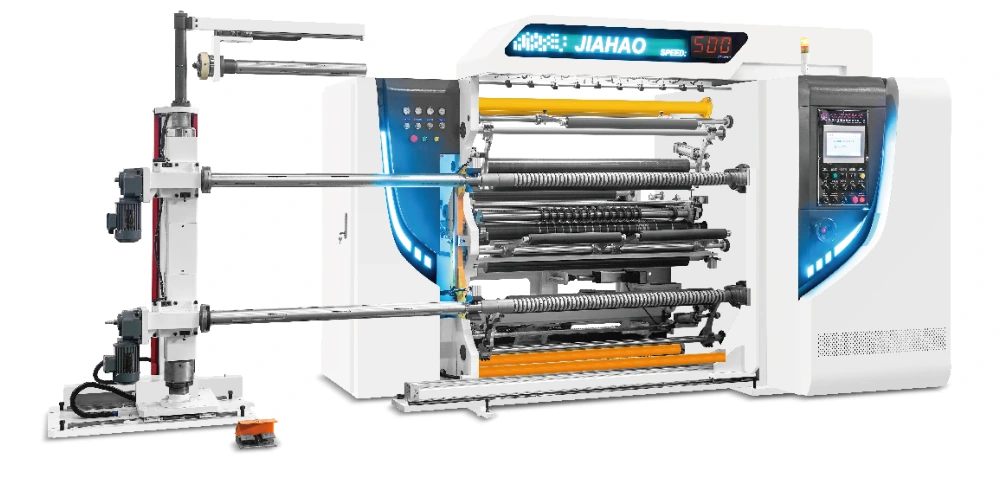
A500, AF500 and B500 use differential rewind shafts at a listed 500 m/min. A400 and AF400 list 400 m/min with larger finished-roll diameters. The fastest listed model is not automatically the best fit for your rolls.
Specify web guiding, tension control, knife setting, loading and finished-roll removal separately. A speed rating does not confirm automatic knife positioning, turret winding or non-stop roll changes.
CONFIGURATION COMPARISON
These configurations are starting points for an application review. Material thickness range, operating speed and achievable roll quality must be agreed for the selected setup.
| Model | Construction and selection | Key configuration values |
|---|---|---|
| QFJ-A500 | A horizontal layout to assess when you need several slit lanes rewound on differential shafts and the parent and finished rolls fit the listed capacities. Start with the web structure and required roll firmness, then review the working width and lane pattern. | Listed speed: 500 m/min Minimum slit: 20 mm Parent-roll diameter: 800 mm |
| QFJ-B500 | Consider the B500 where the web and required finished rolls fit a vertical layout with a smaller diameter envelope. Compare access for threading, core loading and finished-roll removal with your operators’ daily workflow, rather than judging installation needs from the machine image alone. | Listed speed: 500 m/min Minimum slit: 20 mm Parent-roll diameter: 700 mm |
| QFJ-C400 | Start with the C400 when centre-surface contact winding is relevant to the finished roll you need. The winding contact, web sensitivity and narrow-lane requirements should be reviewed together. The separate-layout configuration shown here lists a larger parent-roll diameter than the connected-layout version. | Listed speed: 400 m/min Minimum slit by width: 5 / 10 mm Parent-roll diameter: 1,200 mm |
| QFJ-AF400 | Start with AF400 when large finished rolls and a separate unwind section are important to the production layout. Compare roll weight, loading access and the finished-roll removal route alongside working width. A larger roll envelope can reduce the frequency of roll changes, but the complete handling plan still needs to suit the installation. | Listed speed: 400 m/min Minimum slit: 30 mm Parent-roll diameter: 1,200 mm |
| QFJ-AF500 | Consider AF500 when differential-shaft winding is relevant and the incoming roll requires more diameter capacity than the A500 configuration. The split construction needs a layout review covering both sections, the connecting web path, loading and service access. Material structure and lane requirements remain central to the selection. | Listed speed: 500 m/min Minimum slit: 20 mm Parent-roll diameter: 1,200 mm |
Roll diameter is separate from working width and roll weight. A listed speed is not a material-specific performance guarantee.
PREPARE YOUR RFQ
Provide grade, layer structure, grammage or thickness, coating and representative material for review.
List parent-roll width, diameter, weight and core; each finished width, lane count, finished diameter and core size.
State target output, quality criteria, utilities, destination and handling needs. Request separate identification of included controls, options, commissioning, delivery basis and acceptance conditions.
BEFORE YOU SPECIFY
No. Actual running speed depends on grade, thickness, slit widths, lane count, roll dimensions and agreed quality criteria. Specify an operating test using representative material.
No. Speed and automation are different attributes. Compare drive, tension and handling functions explicitly rather than calling a lower-speed powered machine manual.
Record material, slit pattern, test duration, operating speed and finished-roll measurements in the agreed acceptance scope. Also identify loading, unloading and operator responsibilities.
TECHNICAL READING
Before comparing slitter rewinders, define the material, parent roll and finished-roll specification. Use this checklist to prepare the operating and supply-scope questions that belong in a machine inquiry.
The right slitting machine depends on what you process and the rolls you need to produce. Start with the material and roll conditions, then compare cutting, winding and operating requirements.
Tension symptoms can originate in more than one section of a paper-slitting line. Record the material, roll stage and conditions under which the issue appears before changing settings or equipment.
YOUR MATERIAL. YOUR FINISHED ROLL.
Send your material and roll specifications to DJH Machinery for a configuration review.