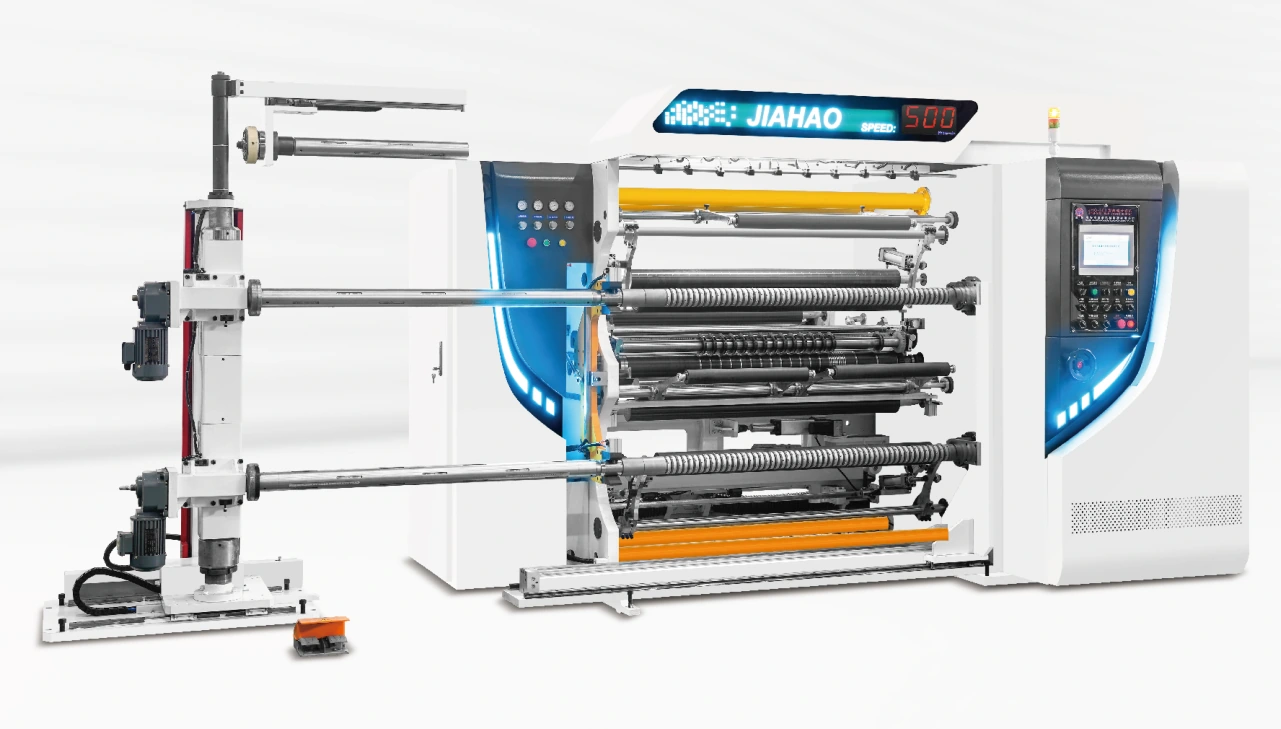
Split Construction
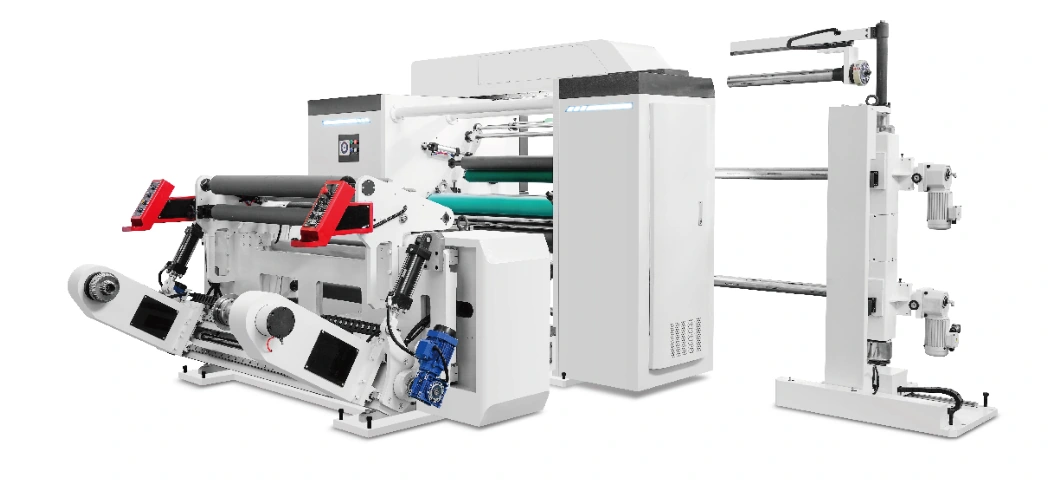
The unwind is separate from the slitting and rewinding section. Review the installed arrangement, web travel and access between the two sections before assessing the floor-space requirement.

SLITTING & REWINDING · QFJ-AF500
Explore differential-shaft rewinding with a separate unwind section. The AF500 lists a 500 m/min slitting speed, 20 mm minimum slit, 1,200 mm parent-roll diameter and 600 mm finished-roll diameter.
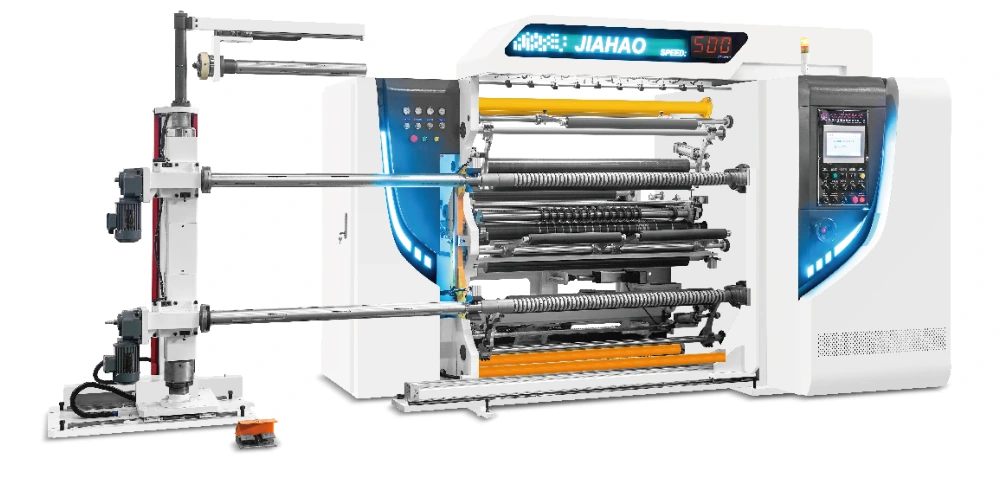
Listed configuration values. Production speed and practical slit pattern depend on the material and the agreed machine setup.
Consider AF500 when differential-shaft winding is relevant and the incoming roll requires more diameter capacity than the A500 configuration. The split construction needs a layout review covering both sections, the connecting web path, loading and service access. Material structure and lane requirements remain central to the selection.
CONSTRUCTION & CONTROL
The unwind is separate from the slitting and rewinding section. Review the installed arrangement, web travel and access between the two sections before assessing the floor-space requirement.
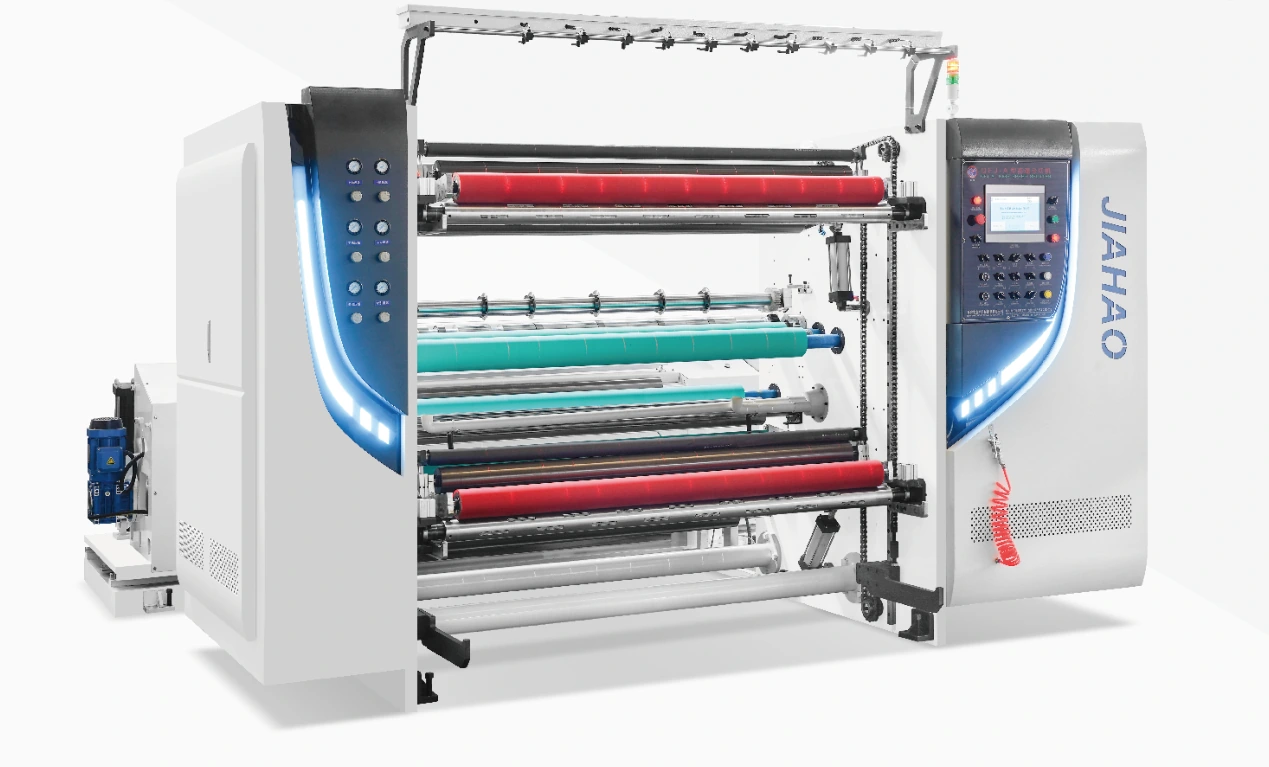
The winding shafts use a differential arrangement, with each shaft controlled by a separate servo motor. Review lane count, core condition and winding firmness using the actual web.
The 1,200 mm parent-roll diameter distinguishes AF500 from the A500 configuration, which lists 800 mm. Confirm allowable mass, core engagement and the loading method separately.
The configuration lists four sets of servo motor control. Width-specific main, rewind and unwind ratings are shown below, but these are individual drive entries rather than a total electrical load.
MATERIAL & FINISHED ROLL
For PVC, BOPP, CPP and PET, describe thickness, treatment side, coating and sensitivity to marking. Check slit edges and roll formation at an agreed operating speed.
Identify each layer and any adhesive or release surfaces. Review tension and contact requirements for the complete web, including behaviour during acceleration and roll build.
Specify paper grade and grammage or foil grade and thickness, with the required edge condition and finished cores. Confirm the cutting configuration for the actual substrate.
WIDTH & DRIVE CONFIGURATIONS
| Parameter | 1300 configuration | 1800 configuration |
|---|---|---|
| Unwinding width | 1,300 mm | 1,800 mm |
| Listed slitting speed | 500 m/min | 500 m/min |
| Minimum slit width | 20 mm | 20 mm |
| Parent-roll diameter | 1,200 mm | 1,200 mm |
| Finished-roll diameter | 600 mm | 600 mm |
| Main servo power | 4 kW | 5.5 kW |
| Rewinding servo power | 2 × 4 kW | 2 × 4 kW |
| Unwinding servo power | 5.5 kW | 7.5 kW |
Drive powers are individual motor entries, not the total installed electrical load. Confirm voltage, frequency, utilities, roll weight and core interfaces with the proposed supply. Required material thickness and production tolerances are application-specific.
SETUP, OPERATION & ACCEPTANCE
Record width, diameter, mass and core dimensions. Use these values to review the separate unwind and site handling equipment.
Define guidance and tension requirements between the sections and establish the slit pattern using representative material.
Review differential-shaft setup and core fit. Check the required firmness, edge appearance and finished diameter across the slit lanes.
Agree dimensional and roll-quality checks and review how the finished rolls will be removed, packed or transferred to the next process.
Review the floor plan, service clearance, roll-handling route and utilities before installation. Agree commissioning and operator-training requirements with the proposal. Keep the machine identification, shaft interfaces and blade dimensions available for maintenance and spare-part inquiries.
A500 and AF500 both list 500 m/min, a 20 mm minimum slit and a 600 mm finished diameter in the configurations shown. AF500 adds a split layout and a 1,200 mm parent diameter instead of 800 mm. AF400 is a different large-roll option with air-shaft winding and a 1,000 mm finished diameter.
BEFORE YOU SPECIFY
Use a matching layout drawing. The separate unwind, web path, roll-loading access and maintenance clearance all affect the installation.
Roll weight, width, core and loading conditions must also fit. Diameter is one part of the incoming-roll specification.
Review the arrangement where several slit lanes are rewound together and lane behaviour or winding firmness is important. Confirm suitability by assessing the actual web and required roll build.
Record model, working width, cutting and winding arrangement, loading and removal equipment, controls, utilities and any optional functions in the quotation.
MATERIAL & PRODUCTION REQUIREMENTS
Compare material requirements and winding formats before defining the final machine configuration.
QUOTATION & SUPPLY SCOPE
Request a QFJ-AF500 quotation against your material, working width and finished-roll targets. Identify the selected version, cutting and winding arrangement, loading equipment and controls in the proposed supply.
Ask for standard equipment and optional items to be listed separately. Include commissioning, operator training, documentation and initial spare-part requirements in the discussion.
Provide quantity and destination. Confirm price, currency, delivery basis, packing, production schedule and any excluded freight or import charges in the quotation.
Agree representative material inspection, measurement criteria and supplied configuration before ordering. Confirm warranty terms, installation responsibilities and spare-part support with the proposal.
COMPARE MACHINE FORMATS
YOUR MATERIAL. YOUR FINISHED ROLL.
Share the web construction, incoming roll, slit pattern and finished-roll requirements. Include the information you already have.