
Are you a paper converter staring at two different customer orders and one wide parent roll? The pressure is on to slice them up efficiently. You're trying to figure out the best combination, but you're worried that what looks good on paper won't work on the factory floor. The truth is, effective planning for paper roll widths is less about pure math and more about balancing material yield with the real-world costs of running your slitting machine.
The best way to plan paper roll widths for two different orders is to create several potential slitting patterns, calculate the trim waste for each, and then—most importantly—evaluate those patterns against your slitting machine's physical constraints and the operational cost of setup time. The goal isn't always zero trim waste; it's the most profitable production run, considering order volumes and changeover costs.
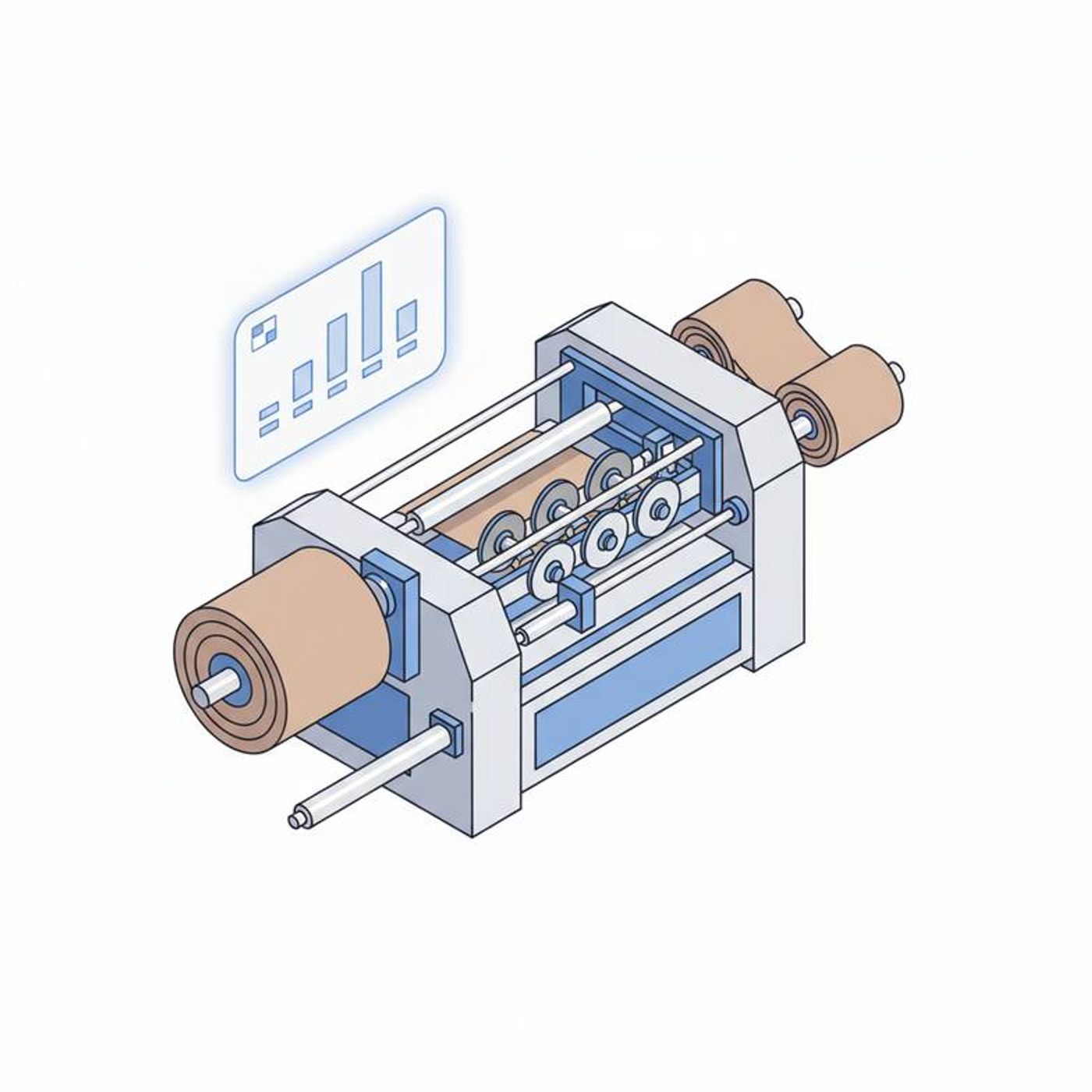
That might sound a bit complicated, but it's a thought process that separates the most efficient converters from the rest. Let's break down how you can move from simple calculations to making truly smart production decisions that improve your bottom line.
Why Is Planning Paper Roll Widths More Than Just a Math Problem?
It’s so tempting to grab a calculator, aiming for that perfect combination of finished rolls that leaves zero trim waste. It feels like a win. But I’ve seen this happen many times: that "perfect" plan gets to the production floor and falls apart. Why? Because the plan didn't account for the machine itself. A profitable slitting plan must start with the physical and operational realities of your equipment.
The answer is that machine limitations like minimum slit width, the physical size of knife holders, and the cost of setup time often have a much bigger impact on your profitability than a few inches of trim. A plan that ignores these factors isn't a plan—it's just a guess.
Let's dive deeper into the real-world constraints that your calculations need to respect.
The Reality of Minimum Slit Width
Every slitting machine has a minimum width it can reliably cut. This isn't just a number on a spec sheet; it's determined by the stability of the slitting station, the type of knives used, and the material itself. Paper, for example, can become unstable and wander if you try to slit it too narrowly.
I once had a customer who wanted to produce a large number of 20mm wide rolls. Their calculations showed they could fit them perfectly alongside another order on their parent roll. The problem? Their machine had a specified minimum slit width of 30mm. Attempting to go narrower resulted in:
- Poor roll quality: The narrow strips would weave and interleave during rewinding.
- Edge defects: The edges were not clean, leading to customer rejections.
- Increased downtime: The operators spent more time trying to fix issues than they did running the job.
Before you finalize any slitting pattern, you must know and respect your machine's validated minimum slit width for the specific paper grade you are running.
The Hidden Cost of Setup Time
This is the factor most often overlooked in purely mathematical planning. Let's say you devise a complex slitting pattern that combines three different widths and reduces your trim waste from 5% to 1%. On a $1,000 parent roll, that’s a material saving of $40. Great, right?
But what if that complex setup takes your operator an extra 45 minutes to complete compared to a simple, single-width setup?
- Operator Labor: If your operator's loaded cost is $40/hour, you've just spent $30 on extra labor.
- Machine Downtime: Your slitter isn't making money when it's not running. If that machine's productive hour is worth $100, you've lost $75 in potential output.
In this scenario, you "saved" $40 on material but incurred an extra $105 in operational costs ($30 labor + $75 downtime). You are now $65 worse off. For high-mix, low-volume converters, it is often far more profitable to accept a little more trim waste in exchange for quick, simple, and repeatable setups.
Knife Spacing and Physical Constraints
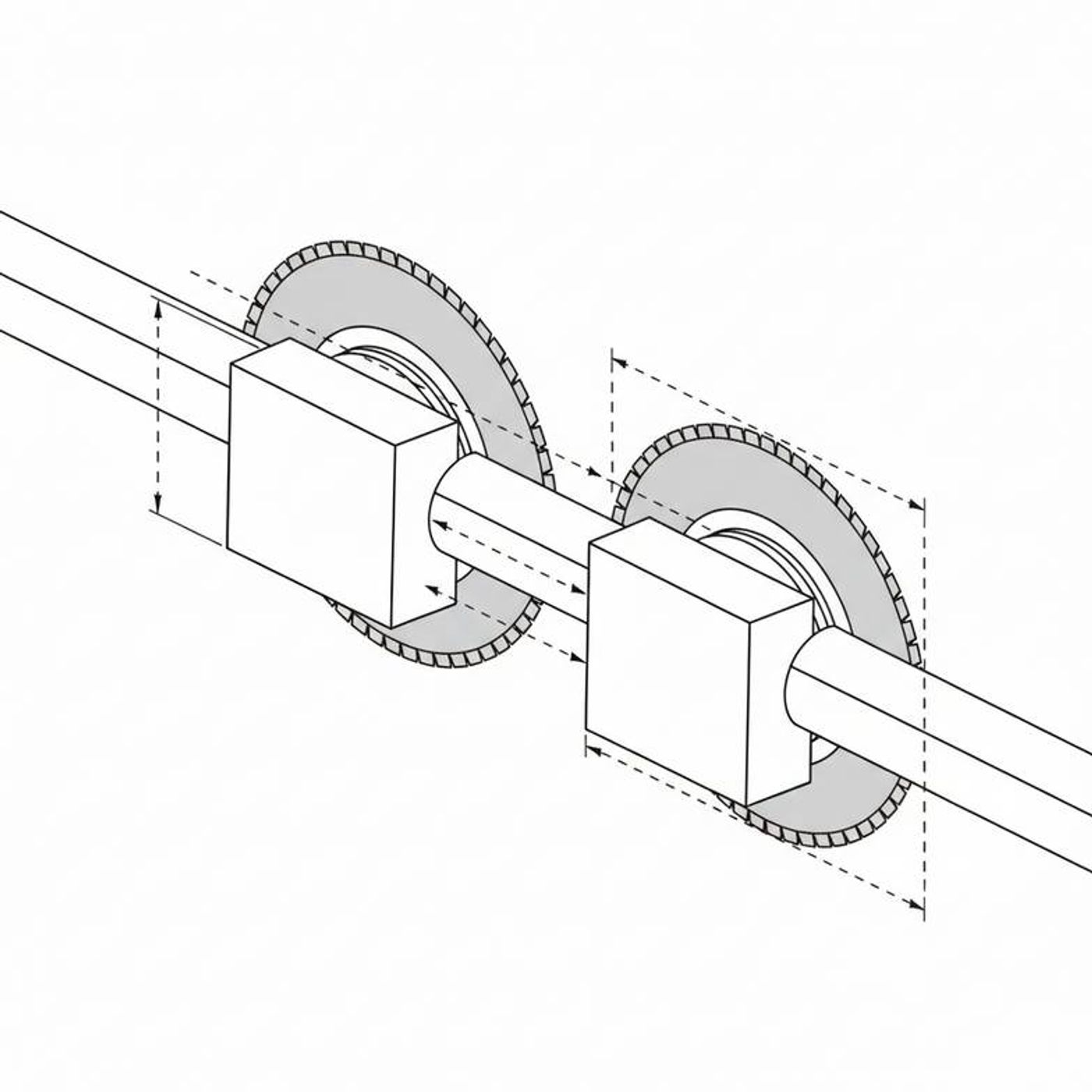
Finally, the slitting knives and the holders they sit in are physical objects with real dimensions. You cannot place two cuts right next to each other. The minimum distance between two adjacent knives is determined by the width of the knife holders, spacers, and the locking mechanism on the shaft.
When you create a slitting plan on a spreadsheet, it’s easy to assume you can make cuts anywhere. For example, a plan might call for a 30mm roll right next to a 40mm roll. But if the combined width of the two knife holders and the minimum required spacer is, say, 10mm, then the centers of those two rolls can't be closer than that. This can make certain "optimal" patterns physically impossible to set up. Always consult your machine's manual or measure the components yourself to understand your true spacing limitations.
How Do You Create a Practical Plan for Different Paper Roll Widths?
So, you understand the constraints. Now, how do you put it all together into a concrete plan for your next job? You feel the pressure, looking at a 1600mm parent roll and orders for two completely different widths. It can be paralyzing. Where do you even begin? The key is to stop searching for one "perfect" answer and instead create and compare a few practical options.
A practical approach involves listing possible combinations (slitting patterns) for your orders, calculating the waste for each, and then—crucially—asking which pattern makes the most sense given your order volumes and setup costs. Let's walk through an example.
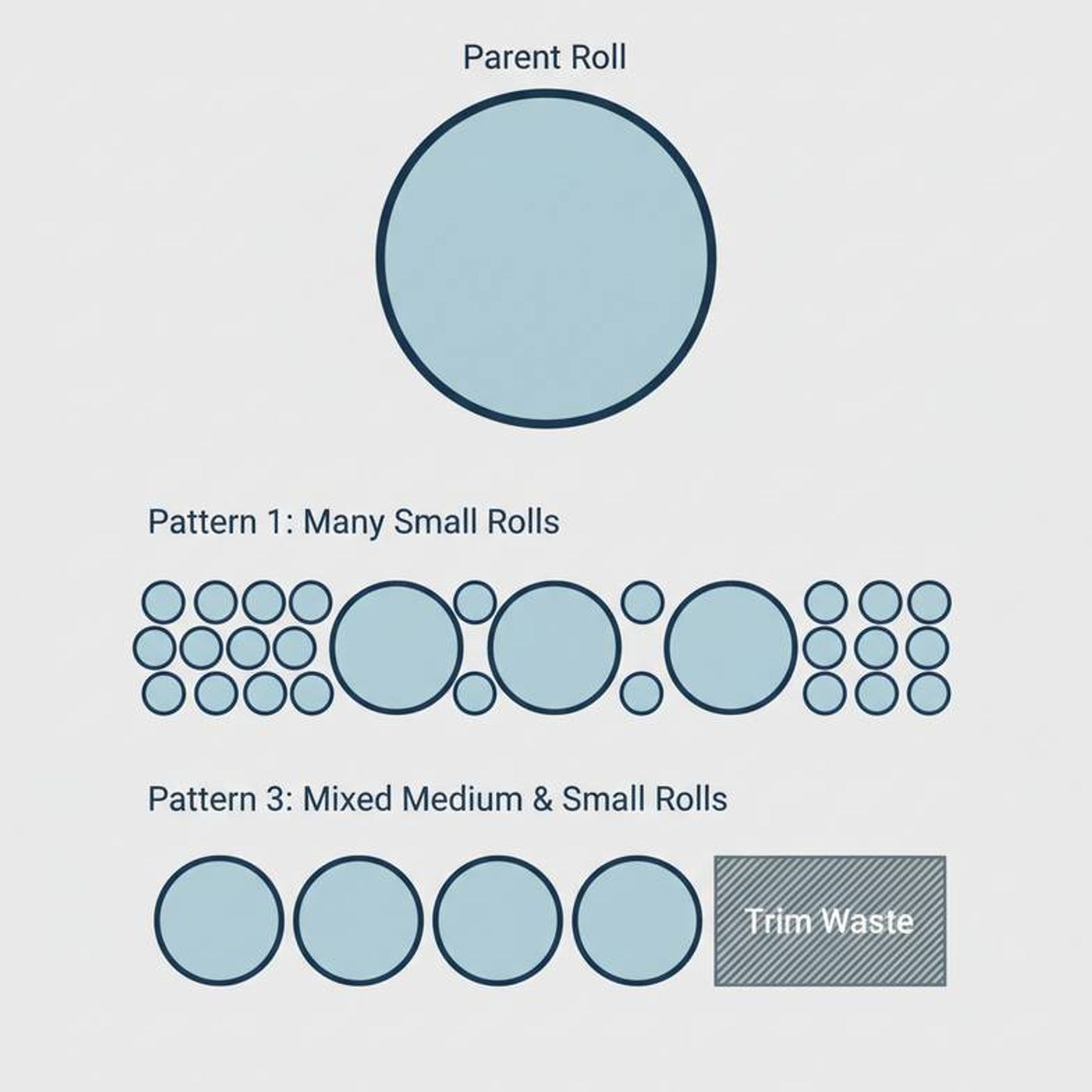
Let's imagine a common scenario I discuss with customers.
Step 1: List Your Constraints and Orders
First, get all your data in one place.
- Parent Roll Width: 1600 mm
- Order A: A large order for 100 mm wide rolls.
- Order B: A smaller, urgent order for 150 mm wide rolls.
- Machine's Minimum Slit Width: 30 mm
- Minimum Knife Spacing: Let's assume it's not an issue for these widths.
Step 2: Develop Potential Slitting Patterns
Now, brainstorm a few ways to combine these on the 1600mm parent roll. Your goal here is to generate options, not find the perfect one just yet. A simple table helps organize your thoughts.
| Pattern | 100mm Rolls (#) | 150mm Rolls (#) | Total Width Used | Trim Waste (mm) | Trim Waste (%) | Notes |
|---|---|---|---|---|---|---|
| Pattern 1: Focus on Order A | 16 | 0 | 1600 mm | 0 mm | 0% | Very simple setup. Fills only Order A. |
| Pattern 2: Focus on Order B | 1 | 10 | 1600 mm | 0 mm | 0% | Perfect material yield, but complex. |
| Pattern 3: Balanced Mix | 4 | 8 | 1600 mm | 0 mm | 0% | Another "perfect" yield, 12 knives needed. |
| Pattern 4: Realistic Mix | 10 | 4 | 1600 mm | 0 mm | 0% | Another "perfect" yield, 14 knives needed. |
| Pattern 5: Simple with Trim | 0 | 10 | 1500 mm | 100 mm | 6.25% | Simple setup for Order B, but creates waste. |
Step 3: Evaluate and Choose the Best Pattern
Looking at the table, Patterns 1, 2, 3, and 4 seem like obvious winners with 0% trim waste. But this is where you must switch from being a mathematician to a production manager. The right choice depends entirely on your order volume.
- If Order B is very small (e.g., you only need 10 finished rolls): Running Pattern 2, 3, or 4 is a terrible idea. You would produce 10 rolls for Order B but also be left with 1, 4, or 10 rolls of 100mm width that you don't have an order for. This creates excess inventory that costs money to store and may never be sold. In this case, the best option might be Pattern 5. You run a simple setup just for Order B, accept the 6.25% trim waste, and get the urgent order out the door quickly. Then, you can run the large Pattern 1 for Order A efficiently without complexity.
- If Order A and Order B have similar, large volumes: A mixed pattern like Pattern 3 or 4 could be very efficient. Since you need large quantities of both sizes, creating them simultaneously in a well-planned run makes sense. The initial setup time is justified by the high volume of output.
The key takeaway is that the most profitable slitting plan minimizes total cost, not just trim waste. Total cost includes material, labor, machine downtime, and inventory holding costs.
What Questions Should You Ask Your Supplier About Planning Paper Roll Widths?
When you're ready to invest in a new slitting machine, the questions you ask will determine the quality of the solution you get. Asking a supplier, "Can your machine handle a 1600mm web?" is a start, but it won't help you solve your multi-order planning challenges. You'll just get a "yes" and a spec sheet. To get a truly useful answer, you need to ask smarter questions that reveal how the machine will perform in your real-world environment.
Instead of asking generic questions about maximums, frame your questions around a specific production problem. A good supplier should be able to engage in this kind of practical discussion. Your goal is to understand the machine's capabilities in the context of your actual work.
Here are some examples of how to reframe your questions for a more productive conversation.
Moving Beyond Maximum Width
- Instead of asking: "What's the maximum web width?"
- Ask this instead: "We frequently run 1600mm parent rolls. Our most common orders are for 75mm and 120mm widths. What is the machine's proven minimum slit width for our paper grade? What are the physical spacing limitations of the knife holders that might prevent us from using certain slitting patterns?"
This question forces the supplier to think beyond the headline spec and consider the practicalities of your job mix. It shows you understand the real challenges.
Questioning Setup and Changeover
- Instead of asking: "Is the machine easy to use?"
- Ask this instead: "For a typical job change involving 10 to 15 knife position adjustments, how long should we budget for a complete changeover? Is this a one-person job? Can you show us the process for unlocking, moving, and locking the knives? Do you offer any semi-automated or laser-guided positioning systems that could reduce setup time for our high-mix production?"
This probes the operational cost of the machine. The answer will tell you a lot about how the machine will affect your overall efficiency, especially if you handle many small orders.
Requesting a Practical Demonstration
- Instead of asking: "Can you send me a brochure?"
- Ask this instead: "We need to evaluate this machine's ability to handle our specific order mix. Can we provide you with a parent roll of our material and a target slitting plan? For example, we'd like to run 8 rolls of 90mm and 5 rolls of 150mm from a 1480mm parent roll. We want to verify the setup time, run speed, and finished roll quality. Can we arrange a sample trial?"
This is the ultimate test. A serious supplier will welcome the opportunity to prove their machine's capabilities with your material. It moves the conversation from claims to evidence, which is exactly where you want it to be when making a significant capital investment.
Frequently Asked Questions
How do I calculate trim waste for a slitting pattern?
Trim waste is the portion of the parent roll that isn't converted into a finished product. The calculation is simple: Trim Waste = Parent Roll Width - (Sum of all Finished Roll Widths). To express it as a percentage, divide the trim waste by the parent roll width and multiply by 100.
Is it always better to combine multiple orders on one parent roll?
No, definitely not. It's often more efficient to run jobs for a single order, especially if the order volumes are very different or if one order is small and urgent. The time and complexity of a mixed setup can easily cost more than the material you save.
What is "slitting pattern optimizer" software?
This is software designed to calculate the best combination of finished widths to minimize trim waste from a parent roll. These tools are a fantastic starting point for generating ideas, but you must always validate their suggestions against your machine's real-world constraints (minimum slit width, knife spacing) and operational costs (setup time).
Does the type of slitting knife affect how I plan my widths?
Yes, indirectly. The primary constraint is the physical width of the knife holders and the minimum distance they can be set apart. Different slitting methods, like shear slitting versus razor slitting, use different mounting hardware. You need to know the specific limitations of your machine's cutting section when planning paper roll widths.
Conclusion
Effective planning for paper roll widths is a strategic skill for any paper converter. It requires a shift in mindset—from chasing the "perfect" zero-waste calculation to finding the most profitable and practical production plan. Remember to always weigh the material savings from a complex pattern against the very real costs of machine downtime and operator labor during setup. The best plan is the one that respects your machine's physical limits, matches your actual order volumes, and minimizes your total cost of production.
At DJH Machinery, we build our customer relationships on these practical discussions. We believe the right machine is one that solves your real-world production challenges. If you're evaluating how to best handle your mix of customer orders, send us your requirements. We can help you analyze the trade-offs and configure a slitting and rewinding solution that truly fits your operational needs.
Continue the Technical Review
For a closer look at the selection and operating questions raised in this guide, read How to Read a Paper Slitter Specification Sheet Without Confusing Roll Diameter and Web Width and compare the recommendations in Horizontal vs Vertical Paper Slitters: Comparing Floor Layout and Roll Handling.